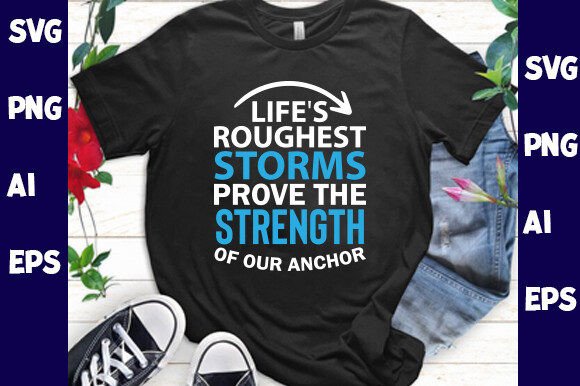
Life’s Roughest Storms Prove the Strength
A Designer’s First Look: Calm, Clear, and Quietly Resonant
When I opened Life’s Roughest Storms Prove the Strength, I didn’t see just text—I saw rhythm. The phrase flows with gentle cadence, not forced symmetry. There’s no ornate script or aggressive drop shadow—just clean, confident lettering with subtle weight variation and generous spacing. It reads like a quiet affirmation, not a slogan. That matters deeply when translating into embroidery. This isn’t a flashy T-Shirt Designs graphic meant for quick screen printing; it’s a thoughtful, emotionally grounded piece that earns its place on a handmade product—not as decoration, but as intention.
Real-World Test: Embroidering It onto a Linen-Cotton Tote Bag
Last week, I stitched Life’s Roughest Storms Prove the Strength onto a natural linen-cotton tote for a local boutique’s “Resilience Collection.” We chose medium-weight stabilizer, 40-weight rayon thread in deep charcoal, and a 5” × 7” hoop. The result? Crisp, legible, and quietly powerful. The letters held their shape without bleeding—even at the curve of the “S” in “Storms” and the fine crossbar of the “t” in “Strength.” No skipped stitches. No thread nests. Just clean satin stitch outlines and soft fill stitch within each character. Customers paused at the display. One picked it up, traced the stitching with her finger, and said, “It feels like something you’d keep for years.” That’s the mark of a design that translates well—not just technically, but emotionally.
Where It Shines (and Where to Pause)
Life’s Roughest Storms Prove the Strength works beautifully on:
- Custom apparel: Sweatshirts, crewnecks, and relaxed-fit tees—especially mid-to-large chest placements or lower back panels.
- Embroidered patch: Stitched on twill and heat-applied to denim jackets or backpacks—it reads clearly even at 3.5” wide.
- Baby embroidery: On organic cotton onesies or burp cloths (with ultra-soft stabilizer), the message lands gently—never heavy-handed.
- Holiday embroidery & personalized gifts: Think embroidered tea towels for Thanksgiving, pillow covers for new parents, or kitchen linens for housewarming gifts.
- Small shop product: It adds quiet sophistication to boutique branding—no logo needed, just sincerity stitched in.
But here’s where attention matters:
- Small hoop sizes: Below 4” wide, letter spacing tightens visually—test before committing to caps or toddler hats.
- Textured or stretchy fabric: On slubbed linen or lightweight knits, use cutaway + tear-away combo stabilizer. Running stitch underlay helps prevent distortion.
- Dark fabric: Light thread (ivory, pale gray) reads cleanly—but avoid pastels that mute contrast. Always test thread colors against your base fabric.
- Dense stitch areas: The “g” and “h” have enclosed counters—check stitch density in your embroidery software. Overly tight fills can cause puckering on delicate weaves.
What It Does for Your Craft Business
As an Etsy seller and small shop owner, I’ve watched how certain phrases build trust faster than others. Life’s Roughest Storms Prove the Strength doesn’t shout—it invites reflection. That makes it ideal for handmade product listings where customers seek meaning, not mass appeal. When paired with a warm photo of the finished product (say, on a cream sweatshirt laid over a wool blanket), it elevates perceived value instantly. Buyers don’t just buy embroidery—they buy resonance. And because the design avoids trendy fonts or dated motifs, it stays relevant across seasons, holidays, and life milestones.
For commercial embroidery projects—like custom orders for therapists, yoga studios, or grief support groups—this design communicates empathy without cliché. It fits seamlessly into printable mockups and digital embroidery file previews because its proportions are balanced and its negative space is intentional. No cropping needed. No awkward scaling.
Practical Notes Every Embroidery Designer Should Keep Handy
Before using Life’s Roughest Storms Prove the Strength in your next project, take five minutes to:
- Test on scrap fabric—same fiber content and weight as your final piece.
- Review stitch density in your editing software. If it’s above 18,000 stitches, consider simplifying interior fills for lightweight fabrics.
- Confirm hoop size matches your machine’s capability—and leave at least ½” margin around the design.
- Inspect small details at 200% zoom: Are corners sharp? Do curves flow smoothly? Does the “e” in “Strength” retain its open counter?
- Test black-and-white mockups to gauge contrast before choosing thread colors.
- Compare light and dark fabric backgrounds—what reads softly on oatmeal may vanish on navy without a shadow layer or backing stitch.
- Use proper stabilizer: Cutaway for knits, tear-away for stable wovens, and fusible for layered garments like aprons.
- Verify licensing: Since this is a digital embroidery file intended for Cricut Design Space, Silhouette Studio, and similar platforms, confirm whether commercial use is permitted before selling finished items or bundling it into design assets.
Final Thought: A Design That Earns Its Place
Life’s Roughest Storms Prove the Strength isn’t just another Graphics download. It’s a design that understands silence—the pause between stitches, the breath before a hard conversation, the stillness after the rain. It belongs on things people hold close: a baby’s first blanket, a therapist’s office pillow, a friend’s “I got you” tote bag. As a designer who’s stitched hundreds of phrases, I can say this one lands with integrity. Not flash. Not noise. Just strength—stitched true.