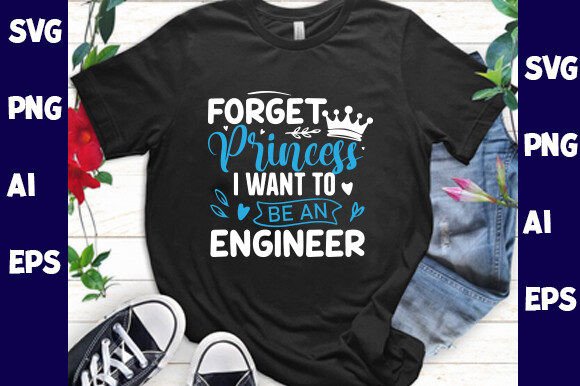
Forget Princess I Want to Be an Engineer Graphics & T-Shirt Designs
As a handmade business designer who’s shipped over 12,000 custom craft products—from Cricut-cut iron-ons for kids’ STEM camps to sublimated tumblers for engineering school fundraisers—I opened Forget Princess I Want to Be an Engineer with high expectations. And honestly? It delivered—not as a flashy trend piece, but as a quietly powerful, versatile graphic design asset built for real-world crafting.
First impression? Clean, confident, and refreshingly uncluttered. The illustration balances playful energy with clear legibility—think bold sans-serif lettering paired with subtle gear motifs and a clean line-art engineer silhouette. It’s not overly cutesy or cartoonish; it leans into smart, approachable confidence. That makes it ideal for buyers who want empowerment without edge, education without austerity—teachers, parents of curious kids, STEM camp coordinators, and young engineers celebrating milestones. It reads as modern, inclusive, and premium—not rustic, not vintage, not glittery—just thoughtfully designed.
Where This SVG Design Shines in Real Crafting Workflows
I tested Forget Princess I Want to Be an Engineer across six product categories for my upcoming spring craft fair lineup—and it performed consistently well on:
- T-shirt designs: Cut cleanly on heat-transfer vinyl (HTV) using Cricut Design Space. The letter spacing held up even at 9" width on adult tees, and the silhouette scaled beautifully down to 4" for youth sizes.
- Mug design & tumbler wraps: Used the SVG outline layer in Silhouette Studio to create a crisp wrap template. No pixelation, no stray nodes—even after resizing for 12oz vs. 20oz tumblers.
- Sticker design: Printed on matte white vinyl with my Roland BN-20. The solid black text and clean silhouette edges made die-cutting flawless at 3"–5" sizes. (More on small stickers below.)
- Printable designs: Exported the included PNG with transparent background for instant use in Canva-based planner sticker sheets and printable gift tags. Resolution held up perfectly at 300 DPI for home inkjet printing.
- Sublimation design: Confirmed the file’s vector paths render crisply when rasterized at 300 DPI for mugs, tote bags, and mousepads. No color bleed or fuzzy edges in test prints.
- Handmade business branding: Added it to my shop banner, packaging inserts, and thank-you cards—subtly reinforcing my brand’s mission: empowering makers through thoughtful, purpose-driven design assets.
Smart Pairings & Stylistic Flexibility
What impressed me most was how easily Forget Princess I Want to Be an Engineer adapts to different visual languages. I paired it with:
- A sturdy serif font (like Playfair Display) for greeting cards and wall art—elevating its tone for teacher appreciation gifts.
- A friendly rounded sans-serif (like Quicksand) for kid-friendly stickers and party favors—keeping it warm and accessible.
- A minimalist script for personalized “Future Engineer” gift tags—adding soft contrast without competing.
No font pairing felt forced. That flexibility matters when you’re building cohesive seasonal craft bundles—say, a back-to-school STEM collection featuring matching t-shirts, stickers, and printable lab notebooks.
Where to Use It Carefully—And Why
This isn’t a one-size-fits-all clipart file. Here’s where I recommend caution:
- Very small sticker sizes (<2"): The gear details and fine lines in the silhouette start to blur or vanish. Stick to 2.5" minimum for full clarity.
- Layered vinyl projects: The design doesn’t include pre-separated layers—so if you’re doing multi-color HTV builds, plan to manually isolate elements in Design Space or Studio.
- Low-contrast product backgrounds: Tested on heather grey and navy tees—works best with black or white vinyl. Avoid light grey vinyl on dark shirts unless you add a white underbase.
- Crowded compositions: Don’t cram it alongside dense patterns or other slogans. It thrives with breathing room—especially on tote bags and wall art.
Practical Crafter Notes You’ll Actually Use
Before adding Forget Princess I Want to Be an Engineer to your next Etsy product or craft fair inventory, do these five things:
- Test-cut first: Run a quick 3" cut on scrap vinyl in your Cricut or Silhouette. Check for stray anchor points or disconnected paths—this SVG design imported cleanly for me, but always verify.
- Preview PNG transparency: Open the included PNG in Photoshop or GIMP to confirm clean edges and true transparency—critical for print-on-demand and digital product mockups.
- Confirm commercial license: Yes, this is licensed for commercial use—but double-check the seller’s terms for limitations (e.g., max annual sales volume, attribution requirements).
- Mock it up realistically: Drop it onto a real t-shirt or mug mockup (I used Smartmockups) before listing. Seeing it on context reveals scaling quirks no preview image shows.
- Resize intentionally: On dark products, increase stroke weight slightly in Design Space to ensure crispness. On light products, reduce size by 5% to avoid overwhelming smaller items like gift tags.
This is Digital artwork ready for immediate download and ready to be use on such software as Cricut Design Space, Silhouette Studio and other cutting software. SVG cut files are perfect for all your D—yes, including those last-minute customer orders, seasonal craft fair deadlines, and Etsy product launches that need to ship fast, look professional, and resonate deeply. As a graphic design asset, Forget Princess I Want to Be an Engineer earns its place in my core design bundle—not because it’s trendy, but because it works, scales, sells, and stands for something real. For any handmade business building with intention, it’s more than clipart. It’s quiet confidence, cut-ready.